“There are many Nicaraguans here”, the taxi driver told us in Spanish, sweeping his leathery hand out the window to indicate the derelict suburb we were driving through. “They come to work and then send money home. Many, many come here.”
I asked him how the Costa Ricans (referred to as “Ticos”) felt about the immigration. “The culture is the same, the language is the same,” he responded, shaking his head. “But they aren’t educated. People look down on them.”
We’d already discussed the upcoming Semana Santa (Holy Week) holiday and been warned that the roads would be extremely busy. Advising us to plan ahead, our kindly driver offered to swing by the bus station on the way to our hostel, so we could buy tickets in advance.
“These men are from the Dominican Republic. It’s easy for them to get a visa. They sell drugs, like this man, look…crazy”. He was staggering across the road, dreadlocks, clothing reduced to greasy rags, a glazed look in his eyes. “They also bring women and sell them for prostitution”. I saw the women too, leaning in a doorway with frosted glass, tight clothing, and garish makeup.
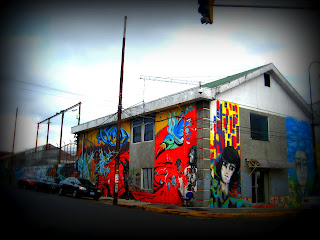
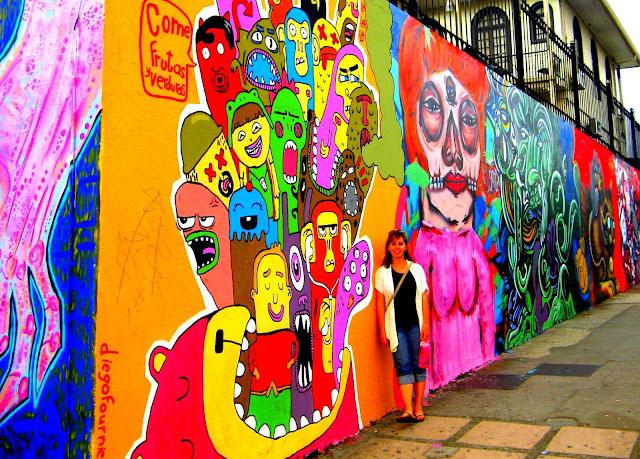
We didn’t stay in San Jose long enough to form much of an impression. Overall, I was disappointed. There were drab concrete buildings, fast food chains, pigeons. On one street, a casino door creaked open, releasing the smell of stale smoke and a middle-aged foreigner with two scantily-clad young women scurrying to keep up in their high heels. We returned to our hostel – the former ambassador’s residence – to find cockroaches scuttling out of the woodwork, unhindered by our presence. “I called the fumigator”, the proprietress said with a sheepish smile, “he’s supposed to come tomorrow”. Thankfully, she let us change rooms.

Criticisms aside, I’m sure San Jose has some hidden charms, for those inclined to stay and look. There are universities and parks where break-dancers congregate. There is also some fantastic street art, which is why I decided to devote an entire entry to a city where I spent a grand total of 1.5 days. There were colorful murals splashed across walls, cartoon figures painted on trash cans, abstracts sprayed across concrete barriers and on the faded walls of condemned buildings.
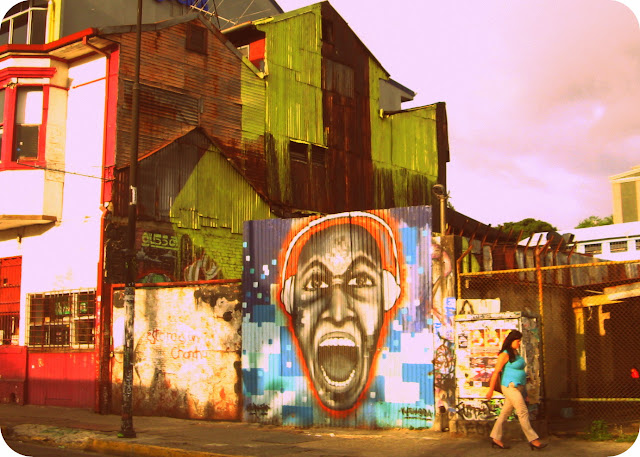
Which brings me to a favorite debate: Can graffiti be considered art or is it simply an act of vandalism? I’m not talking about a few obscenities scrawled over the window of a city bus, but rather work that, while perhaps reflecting discord with current events also has a deeper social message. The website RECLAIMYOURCITY.NET states that “urban public spaces are reserved for those who have enough money. Advertising dominates the urban landscape, and we are constantly bombarded with slogans from multinationals everywhere we go. Architecture and the streets are shaped by commercial interests, not by the residents of the city. It is impossible to avoid, the public have no access to these spaces, that is, unless we claim them for our own.” So why not create a public space where artists are free to experiment? This can not only enhance a rather bland cityscape, but also provide people with a creative outlet to express themselves.


